Monday, July 27, 2009

Alaska - the nests & chicks

While wandering across the tundra on the hunt for godwit nests we would regularly stumble across nests of other birds. Often this discovery arose following the heart-stopping flush of bird from the nest as we stepped only centimetres away. Ptarmigan often gave the most dramatic flush from the nest. Nest discoveries sometimes proved useful for other researchers in the area at the time, such as those working on Short-eared Owls or Pacific Golden Plovers. The size of a clutch would vary - all Godwit nests we found had 4 eggs, long-tailed Jaegers 2 eggs, but Ptarmigan nests typically had over 10 eggs, the largest I found had 14. There was also a variety of nest type and colouration of eggs. Here's a few examples


Ptarmigan Nest
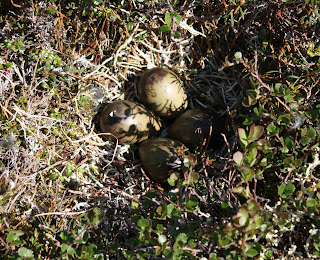
Godwit Nest

Short-eared Owl Nest

We were also fortunate enough to still be around as the chicks hatched. It was always a delightful sight seeing a chick bumbling its way across the tundra, in the company of the adult or hunkered down on a nest.

Short-eared Owl

Of particular interest was the fact that due to the abundance of voles and lemmings the clutches of some birds, such as Rough-legged hawks, was unusually large. In the photo below you can see a picture of a Rough-legged hawk chick, one of 6 in the nest. According to Ted Swem, a biologist who has been studying rough-legged hawks for 25 years, the typical clutch is 2-3. He had seen only two clutches of 6 in the past 25 years.

Thursday, July 16, 2009

Alaska - the other wildlife


So there's no denying that one of the major perks of being in Alaska was being able to see such amazing wildlife every day we headed out into the field. While the bears stayed at a comfortable distance, I did find myself wishing for a closer encounter (though not too close!). Winning us over the most were the Musk Ox. We saw them every day, with one exception, and delighted in observing them with their young.


Reindeer were a common site in the area and we were told by a local Inupiat how they would round them up using helicoptors and remove their antlers for sale to overseas markets, a valuable source of income for the indigenous communities. The Red Fox we saw were few and far between, but we did encounter depredated nests (why not predated one asks?) which could have fallen victim to a fox visit.

The Arctic ground squirrels were great little companions, popping up in all sorts of places as if to say Hi. I love New Zealand and I love our birds, but I sometimes wish the country had evolved with a few mammals present so we could have our own encounters in the bush, as they really add to the whole experience out there. I'm not sure our introduced possums, deer & pigs cut it I'm afraid. That said, we probably wouldn't have such iconic birds like kiwi, kakapo and takahe had that been the case. I suppose it means I just have to keep travelling!

Alaska - collecting data

During our time in Alaska, the focus was on catching male Godwits, such as this gorgeous male with the most stunning breeding plumage. Unfortunately, despite a number of treks across the tundra to this male's breeding area, we never managed to catch him. He was just too clever.

However, of the ones we did catch we recorded typical data such as mass, bill length, wing length, and plumage details. We also collected feather samples to analyse for melanin content and to score the degree of wear.


Before releasing the birds we would add Aplha numeric flags and metal bands so they can be identified in the future, hopefully this summer back in New Zealand! So keep an eye out for J6, J8, J9, K0, K1, K2, K3 and K4, coming to an estuary near you soon.

Alaska - the catching

As you can see from the photo below, the Alaskan tundra is a vast expanse of low lying vegetation, pocky mounds, typically moist and below which lies a layer of permafrost. In this vastly different habitat from the inter-tidal mud flats, godwits nest... somewhere. We had to find that somewhere. Our job had four key steps: 1. Find the birds. 2. Find the nest 3. Catch the birds on the nest 4. Process and release the birds. However, both step 1 and 2 required hours upon hours of work each, mixed with a large measure of good luck. Once we had established typical "Godwit habitat", finding the birds became less problematic, but finding breeding birds was always a challenge. We needed birds on the nest to capture because Godwits typically sit tight on the net and don't flush until a person is remarkably close, in fact, in all cases we could lower the net over the bird and it would stay on the nest!


Locating the nest typically involved relying on viewing a nest exchange (where the male swaps with the female to incubate the eggs, or vice versa). Working on the assumption of 12 hour shifts we would observe foraging individuals to work out schedules and predict when an exchange might occur. Sometimes this worked perfectly, other times not at all... maybe the 12 hour shift idea was a good assumption, maybe not? Once the nest was located however, the next steps of catching and processing the bird could be completed within an hour.

The photo above shows Jesse and I taking the net to lower over a Godwit. The photo below is of a female Godwit still on the nest, look carefully and you can see the net at the top of the photo!
Once the eggs had hatched, catching relied on an entirely different approach and involved catching the young chicks briefly so that the parents would swoop in and be caught by a mist net being flicked up with perfect timing. We also tried various other strategies, such as using recorded chick calls and decoys (to little effect mind you). All up we caught 9 Godwits and 3 Red Knots. This might seem like small numbers, but it has been known for people to be out for up to 6 weeks and not catch a single bird on the breeding grounds. They can be very illusive.


Friday, June 26, 2009

Alaska


Well I made it to Nome, Alaska about a week ago now and have had a brilliant first week here. The godwits have been tricky to find but strategic searching, along with networking with other birders and some good luck has enabled us to catch three pairs of godwits on the nest. To our knowledge, this is the first time pairs of godwits have been caught on the breeding grounds.

The weather is warmer than anticipated, so the mosquitos are out in force on still days, never before have I been happy for the wind.

The wildlife as we travel around is stunning - musk ox are seen daily, bears, squirrels, Artic hares, moose and caribou have all benn seen. It's great.

Friday, June 12, 2009

Fellowship Reflections (week 20)

The Pandemic has begun


Last night, just four days before I am due to travel 36 hours sardine-like in an aeroplane and associated congested airports, the World Health Organisation announce the world is officially experiencing a flu pandemic. Does this really make any difference? Honestly, I don't know, it will depend on how others react and what officials decide to do about it. No recommended changes to international travel are recommended at this stage, so I am feeling comfortable about it all. That said, I have taken advice and armed myself with Tamiflu and facial masks for my travel. My only concern really, is getting some small cold or sniffle and being quarantined as a "suspected case" because I exhibit "flu-like symptoms". Here's hoping all goes smoothly and come mid-next week I find myself comfortably enjoying the view from my cabin in Nome - better still, from my wanderings across the Alaskan tundra!


One of my highlights of this week was getting back into the classroom again, admittedly with students much younger than I am used to. I was able to visit a bunch of great kids at Aokautere School who are studying Antarctica. I was able to take down some of the museum resources from the Ecology Department, such as a King Penguin and Polar Bear skull & leg. I was able to link in their studies with some of my work on Godwit migration, comparing some the geology and fauna of the Arctic with Antarctica. It was great fun.


Next time I write will hopefully be next week from Alaska!

Monday, June 8, 2009

Fellowship Reflections (week 19)

A close shave

Over this week the four of us heading to Alaska depart with various separate schedules. The first to leave was Jesse on Saturday, reason being, he was to visit Fairbanks to look at museum specimens of godwits - take photos and do some spectrometry work. However, in the 5 months here at Massey we had no success in getting the spectrometer to work as we required. First attempts back in February centered around trying to get the light source (a Xenon PX-2) to fire up while connected to the spectrometer. We then found out from the sales rep. that we were missing the breakout box, a critical part that assisted communication between the two pieces. That then got ordered. Arriving April or so, we tried again. Still no luck - we then had to go through each part to work out where the problem lay. We finally identified the actual spectrometer had faults and so needed repairing. Now early May we faithfully shipped it off to the States with URGENT written all over it, hoping repairs could be completed prior to our departure, early June. Well, Wednesday last week the part arrived, 3 days before Jesse headed off and needed to take it with him. We carefully put all equipment together, having already tested each part knowing individually they worked, we then pressed the critical ON button and... silence. It still didn't go! Grrrrrrr!! Thursday morning, as a final desperate check, we were up at the Chem lab at Massey (they had a functioning unit we could troubleshoot with), we then piece by piece replaced their parts with ours, the hope was to create our own fully functioing unit. Eventually we found that one cable was the cause of the problem - the thing was, for the whole system to work the cable actually needed to be inserted upsidedown! So, now with just over one day to go before departure, we needed to perfect the actual use of the gear. Talk about cutting it fine!

Here's the setup I'm talking about...

Innocuous looking stuff, caused us enough grief though. Anyway, positive outcome in the end.

So, Saturday was a great day because I got to pick up my Sibley Field Guide to North American Birds. I've always travelled with a field guide for each country and have a great stash of them in my book shelf. This one though will be very special as the birds we see in Alaska are going to be just amazing. I will of course, gleefully scribble each sighting in my book as a wonderful record of my time up there. I love being a bird geek!