
The birds flying in at dusk - Miranda
Last weekend we made a journey up to Miranda to do some mistnetting over a couple of nights. The main goal was to catch Godwits and Red Knots to collect blood from the juveniles that had overwintered in New Zealand rather than migrating north to the Russian/Alaskan breeding grounds. These birds would then be used as a comparison group to the adult godwits and knots that are due to arrive back from the breeding grounds this month. We aim to catch some of these birds soon after their arrival, again collecting blood, to look at their physiology such as amount of muscle fatigue. While not specifically for the project I'm working on we did take the opportunity to get samples of any red plumage that birds had on them.
As you can see from photo, it was a beautiful evening on the first night but perhaps too clear and the high tide a little too early as the birds flew over to the stilt ponds just prior to total darkness. As a consequence many avoided the mist nets. Consequently, our catch of godwits was low, just the one. We did catch half a dozen red knots and a huge number of South Island Pied Oystercatchers (SIPO) which we didn't particularly need for the study, but banded for records. On the second night the godwits showed their superior intelligence and figuring we were up to something, didn't come into the stilt ponds at all. Still plenty of SIPO though, even a recapture from the night before! This did mean I had the opportunity to upskill on my banding with the fine teaching of Gillian Vaughan. Always good to be the field!
 Me banding a SIPO


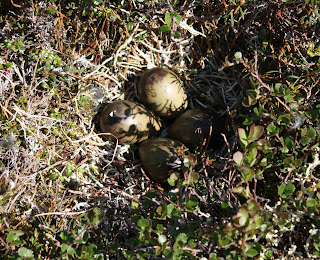 Godwit Nest


 Reindeer were a common site in the area and we were told by a local Inupiat how they would round them up using helicoptors and remove their antlers for sale to overseas markets, a valuable source of income for the indigenous communities. The Red Fox we saw were few and far between, but we did encounter depredated nests (why not predated one asks?) which could have fallen victim to a fox visit.
 The Arctic ground squirrels were great little companions, popping up in all sorts of places as if to say Hi.
  I love New Zealand and I love our birds, but I sometimes wish the country had evolved with a few mammals present so we could have our own encounters in the bush, as they really add to the whole experience out there. I'm not sure our introduced possums, deer & pigs cut it I'm afraid. That said, we probably wouldn't have such iconic birds like kiwi, kakapo and takahe had that been the case. I suppose it means I just have to keep travelling!
 However, of the ones we did catch we recorded typical data such as mass, bill length, wing length, and plumage details. We also collected feather samples to analyse for melanin content and to score the degree of wear.


 The photo above shows Jesse and I taking the net to lower over a Godwit. The photo below is of a female Godwit still on the nest, look carefully and you can see the net at the top of the photo!
